- HOME
- MEET Tosin
From Uncertainty to New Life: Meet Tosin Ajayi
My name is Tosin Ajayi, and I am one of the beneficiaries of the free HIFU fibroid treatment at the Fibroid Care Centre at Nordica.
For a long time, I struggled with very heavy menstrual bleeding, painful periods, and large clots. My period was never light, even from when I started menstruating at the age of 11. But late last year, I noticed something around my lower abdomen. At first, I thought it was nothing serious, but as time went on, my periods became heavier and more difficult to manage.
The moment that made me realise I needed medical help happened during a trip to Osun State. I kept asking the driver to stop at different points because I needed to change my pad. That was when it dawned on me that something was wrong.
I later went to the hospital, where I was asked to do an ultrasound. The result showed that I had fibroids. When I heard the diagnosis, I was broken. I cried all through that day. I kept asking myself, “Why me?” I was still single, not yet married, and I had not had children. Like many women, I had heard so many scary things about fibroids, especially the fear that it could affect fertility or make it difficult to carry a pregnancy.

My biggest fear was surgery. I did not want to go under the knife. So when I learnt about HIFU treatment, it felt like a lifeline. That was the first time I realised fibroids could be treated without open surgery. I read more about HIFU, joined a webinar, and began to understand that it was a safer and faster treatment option. The only challenge was the cost. HIFU is expensive, and I did not know how I would afford it.
So when I got the opportunity to receive the treatment at the Fibroid Care Centre at Nordica, I applied. I was not expecting to be chosen, but I was selected. I felt very lucky and deeply grateful.
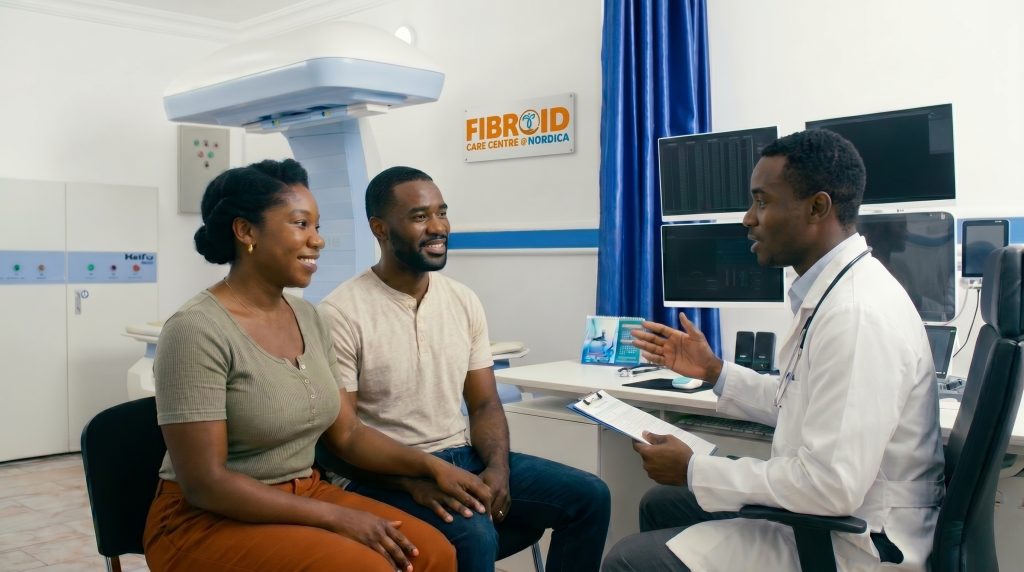
My first visit to the Fibroid Care Centre was reassuring. A nurse attended to me and asked questions about my medical history and personal information. Afterwards, I had a consultation with the gynaecologist. I began to understand the process better, and I felt more confident about the treatment journey ahead. The next step was an MRI scan, which would help the doctors see the exact position, size, and number of fibroids.
On the day of the MRI scan, I was excited but also scared. I had read that the scan was painless and not harmful, but seeing the machine made me nervous. I wondered how I would stay still inside it for that long. But after seeing other people go in and come out fine, I encouraged myself and went ahead with the scan.
On my next visit, the doctor reviewed my MRI result with me and explained what he saw. I also did some blood tests to confirm that I was fit for the treatment. After that, I went through bowel preparation and skin stimulation in preparation for the HIFU procedure.
When the treatment day finally came, I was full of expectation. I kept hoping that after everything, I would finally be free from the symptoms of fibroids. I wanted to live normally again without being afraid of my period, without worrying about pain, heavy bleeding, clots, frequent urination, and the discomfort I had lived with for so long.
After the HIFU treatment was completed, I could hardly believe it. HIFU means High Intensity Focused Ultrasound, and the process was nothing like regular surgery. I was not transfused. I had no pain. I had no burns. I simply lay on the machine for about two hours. When the doctor told me the treatment was done, I was surprised. I even asked, “Sir, are we done?” It felt almost unbelievable.
The biggest change came after my next period. For the first time in my life, my period was painless. I did not need pain relief. The flow was normal, and the big clots I used to see were no longer there. The heaviness in my lower abdomen also reduced. Before, I could eat just a few spoons of food and feel like I had eaten a full bowl. That feeling was gone. I also stopped urinating as frequently as before.
Almost all the symptoms I had before the treatment disappeared. For me, HIFU has been a lifesaver. I am happy I went through the treatment, and I am grateful that I was selected as one of the beneficiaries.
To every woman living with fibroids, my advice is simple: do not lose hope. Fibroid is not the end of the world. Early detection is very important. If you notice heavy bleeding or anything unusual, please go to the hospital, run the necessary tests, and get the right medical advice.
Today, I am doing fine, and I am thankful that my health has been restored.
Thank you, Fibroid Care Centre at Nordica. God bless you.
Why Choose Us
Since its establishment in 2021, Fibroid Care Centre @ Nordica has become one of Nigeria’s leading destinations for the diagnosis and treatment of fibroids and other gynaecological conditions. Patients choose the centre for its blend of advanced non-invasive and minimally invasive procedures, experienced specialists, personalised care, and a strong commitment to helping women achieve better health and improved quality of life. It’s easy to see why.
Pioneers in Non-Invasive Fibroid Treatment
We established the first ultrasound-guided HIFU Centre in Nigeria and West Africa, offering advanced non-invasive treatment options for fibroids and other benign uterine conditions.
Expertise You Can Trust
Our multidisciplinary team of experienced doctors, nurses, and fertility specialists provides evidence-based, patient-centered care tailored to each woman’s unique needs.
Proven Experience
With over 900 successfully managed cases, our team has built significant expertise in delivering safe and effective non-invasive fibroid care in Nigeria.
Faster Recovery, Better Quality of Life
Our minimally invasive and non-invasive therapies help women return to work, family life, and daily activities more quickly compared to traditional surgery.
Fertility-Preserving Care
We understand the importance of reproductive health. Our treatment approach prioritizes preserving the uterus and supporting future fertility whenever possible.
Advanced Technology
We utilize the internationally recognized Chongqing Haifu HIFU system, enabling incisionless, bloodless, and uterus-preserving treatment with minimal downtime and reducing risk of recurrence.
Holistic Women’s Health Approach
Beyond fibroid treatment, we provide comprehensive care addressing symptoms, fertility concerns, emotional well-being, and long-term reproductive health outcomes.